Hume Body Pod Review: How Accurate Is This Smart Scale Really?
Quick take: a well-built home scale that reads far more than weight, and one of the few with independent third-party testing behind it. Bought as a trend tracker, it delivers. Bought expecting clinic-grade numbers on any given morning, it will frustrate you.
Around $224, down from a list price of about $358, with free shipping and a 1-year warranty included. Promotional pricing rechecked October 2, 2026. Pricing, availability and warranty terms are set by the merchant and may change — confirm current terms on Hume Health's website before purchasing.
The link opens Hume Health's home page — select Shop Now under the Hume Pod to reach the product page.
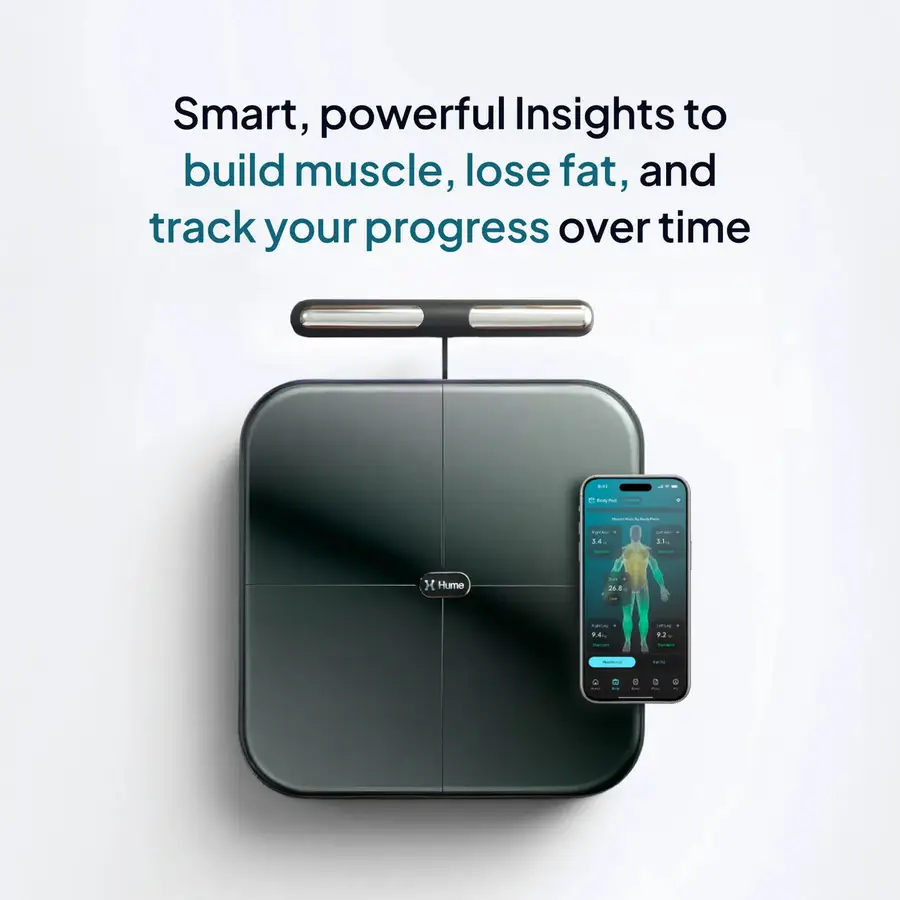
What is the Hume Body Pod?
What is it, in one line?
A bathroom scale with a retractable handle that runs a small electrical current through your body to estimate what you're made of — not just what you weigh.
Step on a normal scale and you get one number, and that number lies to you constantly. Lose two pounds of muscle and gain two of fat and it says nothing changed. That's the problem this device is built to solve.
The Body Pod uses bioelectrical impedance analysis, or BIA. Sensors in the platform send a harmless current up through your legs, and the handle you pull up and hold sends it across your torso and arms. Because muscle holds more water than fat, the current meets different resistance in each, and the device works backwards from that to estimate composition.
The handle matters more than it sounds. Foot-only scales measure the current's path through your lower body and estimate the rest. Adding the handle gives the device a second path — through the torso and arms — which is why it reports segment-level numbers instead of one whole-body figure.
Everything lands in the free Hume Health app, which syncs with Apple Health and Google Health Connect, so your weigh-ins sit alongside workouts and sleep from whatever else you already wear.
What it actually measures
Is it really 45 different metrics?
Yes, but read that number correctly. Around 20 are directly measured core totals. The rest are breakdowns and trends the app derives from those — useful, but not 45 independent readings.
The core group is what you'd expect from a serious composition scale: weight, BMI, body fat percentage, fat mass, muscle mass, body water, bone mass, protein, visceral fat and basal metabolic rate. From those, the app builds segment views (arms, legs, torso), balance comparisons between left and right, and trend lines over weeks.
The measurement itself takes under a minute and a half. Worth noting: Hume Health's own product page gives two different figures — "under 60 seconds" in one section and "in just 90 seconds" in another. A small thing, but it's the kind of detail that tells you how carefully the marketing copy was checked.
How accurate is it, honestly?
Does it really match a DEXA scan?
Not literally, and the brand's own published research is the clearest evidence of that. It is accurate enough to trust the direction you're moving. It is not accurate enough to treat any single reading as clinical truth.
Hume Health's marketing leads with a 98% accuracy figure against DEXA, the X-ray scan used as the reference standard for body composition. Independent write-ups have reported third-party testing placing the device within a few percent of DEXA under controlled conditions, which would be a genuinely good result for a home device. We were not able to read that testing at source, so we're reporting it as claimed rather than confirmed.
What we could read at source is more interesting — and it comes from Hume Health itself.
The manufacturer's own study names the limits
Hume Health publishes research on its site using the Body Pod to track lean mass during GLP-1 weight loss. In the limitations section of that write-up, the authors state plainly that body composition was measured "via bioelectrical impedance analysis rather than dual-energy X-ray absorptiometry (DXA)", that "BIA measurements are sensitive to hydration status, time of measurement, and device calibration", and that stronger evidence would require "DXA-validated BIA calibration".
That is the company describing the boundaries of its own technology, in its own publication. We think it's more useful than any marketing number — and it tells you exactly how to get good data out of the device.
About that comparison table
Hume Health's own site runs a chart comparing the Pod against a "medical grade analyzer" and a generic smart scale. It gives the Pod 98% accuracy — and gives the $25,000 medical analyzer the same 98%.
| As claimed by Hume Health | Hume Pod | Medical grade analyzer | Other smart scale |
|---|---|---|---|
| Accuracy | 98% | 98% | 89% |
| Price | $229 | $25,000 | $80 |
| Weekly health reports | Yes | No | No |
| HSA/FSA eligible (US) | Yes | No | No |
Read it literally and it says a $229 bathroom scale measures body composition exactly as well as a device costing more than a hundred times as much. That is a very large claim to make in a marketing chart with no methodology attached — no explanation of which metric was compared, against what reference, or under what conditions.
It also sits awkwardly next to the company's own research, quoted above, which says the honest thing: BIA is not DXA, and readings move with hydration, timing and calibration. Both statements come from the same company. We'd trust the one with the citations.
Two smaller inconsistencies worth knowing: the comparison chart lists the Pod at $229 while the product page itself now shows $224, and the site carries a "#1 Choice For Health Professionals" badge with no source given for the ranking. Neither is a dealbreaker — both are reminders to read the product page as advertising, which is what it is.
So here's what to actually do. Weigh in at the same time every day, ideally first thing in the morning, before eating or drinking and after using the bathroom. Don't weigh in after a workout or a salty dinner. Then ignore the daily number entirely and read the weekly line. Used that way, the device is genuinely reliable at showing whether you're holding muscle while losing fat — which is the question it exists to answer, and the one an ordinary scale can never touch.
Sources: Hume Health product and research pages, and the published refund and shipping policies, all read in August 2026.
What using it is actually like
The daily routine is short: step on barefoot, pull the handle up, hold it at chest height and stand still. The app picks up the reading over Bluetooth before you've finished drying your hair.
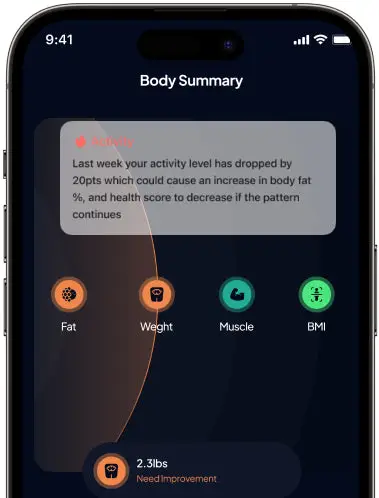
Where it earns its keep is the weekly report. Instead of a wall of numbers, the app shows you the two lines that matter — fat mass and muscle mass — moving in opposite directions, or not. That single view is what makes people stick with a scale like this instead of abandoning it in week three.
Because it feeds Apple Health and Google Health Connect, the readings also flow into whatever else you already use, so you're not maintaining a separate health silo.
Pros and cons
✔ What we liked
- It answers the question a normal scale can't. Seeing fat mass fall while muscle mass holds steady is the difference between knowing your plan works and hoping it does.
- The handle earns its place. Eight sensors across two current paths give you arm, leg and torso breakdowns instead of one whole-body guess extrapolated from your feet.
- The core app is free. Your measurements and trends don't sit behind a paywall — the subscription is an upsell, not a gate.
- It plugs into what you already use. Apple Health and Google Health Connect sync means the data joins your workouts and sleep instead of living alone.
- The company publishes its own research — including the limitations. That's rarer than it should be in this category, and it's a reason to trust the hardware more, not less.
- Free shipping, and 30 days to change your mind. Delivery runs 7–10 business days with tracking.
⚠ What to know before you buy
- The 98% accuracy claim is broader than the evidence. → Treat the device as a trend tracker and you'll be happy with it; treat it as a home DEXA and you won't.
- The 10-year warranty is a paid add-on, not an inclusion. → It's $46 at checkout and $70 later, so decide before you reach the payment step.
- Readings move with hydration and timing. → Same time every morning, before food and drink. The routine fixes almost all of the noise.
- Returns cost you $10. → The restocking fee applies within the 30-day window, and the box must be intact — so keep the packaging until you've decided.
- It's not a medical device and has no FDA clearance. → Fine for tracking yourself; if you need a clinical number, ask your doctor about DEXA.
- Some headline results come from a 60-person survey. → The "12x faster" style claims are footnoted as self-reported by n=60 members, so weigh them as marketing, not evidence.
Who it's for — and who should skip it
✔ A good fit if you…
- are losing weight and want to know whether you're losing fat or muscle
- are lifting and want proof the muscle is actually arriving
- are on a GLP-1 medication and have been told to protect lean mass
- already track sleep or training and want composition in the same place
- will weigh in consistently — the device rewards routine and punishes randomness
✕ Look elsewhere if you…
- have a pacemaker or another implanted electronic medical device
- are pregnant — BIA readings aren't reliable in pregnancy
- need a clinical-grade number for a medical decision
- want one weight figure and nothing else — a basic scale does that
- know you'll weigh in at random hours and then distrust the results
If you're managing a medical condition or taking regular medication, talk to your doctor or pharmacist before using any bioelectrical impedance device.
Price, warranty and returns
What do you actually pay?
Rechecked on October 2, 2026: about $224 — discounted from a list price of roughly $358 — with free shipping, the core app and a 1-year warranty included. The 10-year warranty is separate, and that is what catches people out.
One year is included. Ten years costs extra.
To be fair to Hume Health: every Body Pod comes with a 1-year warranty as standard — their own checkout says so plainly. That covers the ordinary "it stopped working" scenario.
The 10-Year Warranty is a separate paid add-on: $46 if you tick the box during checkout, $70 if you decide to add it later. Because the product page features "10 years" so prominently, it is easy to reach the cart assuming a decade of cover is already included. It isn't.
It is a fair deal at $46 — full hardware and sensor cover, plus on-request recalibration servicing, which genuinely matters on a device whose readings drift if it goes out of calibration. Just decide before you reach the payment screen, because the same cover costs $24 more afterwards.
Returns, in the merchant's own words
The published refund policy gives 30 days. To qualify, the device must come back in its original packaging in like-new condition and must have been purchased from Hume Health directly. A $10 restocking fee applies, and the refund is only processed once the scale reaches their warehouse. Practical takeaway: keep the box somewhere safe until you're certain.
Shipping is included, and the shipping policy states 7–10 business days after processing, with tracking emailed to you.
Read on Hume Health's published refund and shipping policy pages, August 2026. Prices and terms are set by the merchant and change without notice — confirm current terms on the merchant's website before purchasing.
Seen enough? Check the current price on Hume Health's website.
Go to Hume Health →The link opens Hume Health's home page — select Shop Now under the Hume Pod to reach the product page.
Frequently asked questions
How accurate is the Hume Body Pod compared to a DEXA scan?
Independent testing by Socotech placed it within about 3% of DEXA, and a July 2026 medRxiv preprint reported strong short-term repeatability and promising agreement with laboratory reference methods under controlled conditions. That is good for a home scale. It is not the same as the brand's headline "98% DEXA accuracy" claim, which is broader than the evidence supports. Treat it as a reliable trend tracker rather than a replacement for a clinical scan.
What does the Hume Body Pod actually measure?
It uses 8-sensor, multi-frequency bioelectrical impedance analysis, with electrodes in the base and in a handle you hold, to estimate around 45 metrics. Roughly 20 are core totals such as weight, BMI, body fat percentage, muscle mass and body water; the rest are derived breakdowns and trends shown in the Hume Health app.
Is the 10-year warranty included with the Hume Body Pod?
A 1-year warranty is included with every Body Pod as standard. The 10-year cover is a separate paid add-on: $46 if you tick it during checkout, or $70 if you add it later. Because the product page features the 10-year figure so prominently, it is easy to assume a decade of cover is included when only the first year is. Decide before you reach the payment step, because adding it afterwards costs more.
Can I return the Hume Body Pod if I don't like it?
Hume Health's published refund policy gives 30 days. The device must come back in its original packaging in like-new condition and must have been bought from Hume Health directly. A $10 restocking fee applies, and the refund is only processed once the scale arrives at their warehouse. Keep the box until you are sure you are keeping the scale.
Is the Hume Body Pod FDA-approved or a medical device?
No. It is a consumer wellness product, not an FDA-cleared medical device, and it is not intended to diagnose, treat, cure or prevent any disease. If you need a clinical body composition measurement, ask your doctor about DEXA or clinical BIA instead.
Does the Hume Body Pod need a subscription?
The companion app and core metrics are included. Hume Health also sells an optional premium program, $9.99 a month with no commitment, that adds a nutrition plan and tracker, personalized coaching and a weekly full-body health report. You do not need it to see your measurements. If you buy a bundle that includes the subscription, note that the refund policy treats the bundle as one unit, so cancelling the software within 30 days requires returning the scale too.
Why do my readings change from morning to evening?
Bioelectrical impedance passes a small current through the body, and the result shifts with how hydrated you are, when you last ate or trained, and even skin temperature. Hume Health's own published research names hydration status, time of measurement and device calibration as factors. Weigh in at the same time each day, ideally first thing in the morning, and read the weekly trend rather than any single number.
Who should not use the Hume Body Pod?
Bioelectrical impedance devices are generally not recommended for people with a pacemaker or other implanted electronic medical device, and pregnancy readings are not reliable. If either applies to you, or you are managing a medical condition, speak to your doctor before using any BIA scale.
How long does shipping take?
Hume Health's shipping policy states that standard shipping takes 7 to 10 business days after the order is processed, with tracking sent by email. Shipping is included at no extra cost.
The Bottom Line
The Hume Body Pod does the one thing an ordinary scale can't: it tells you whether the weight you're losing is fat or muscle. The marketing oversells the precision, and the 10-year warranty costs extra — but as a weekly trend tracker, bought with clear eyes, it delivers. The Modern Life does not sell it; if you decide to buy, the purchase is completed on Hume Health's website.
Check Current Price on Hume Health →